
Medical manuscript proofreading involves more than correcting grammar, punctuation, and spelling. For clinical researchers, it also requires checking medical terminology, verifying clinical trial registration details, and ensuring that reported outcomes align with the registered protocol and statistical analysis plan. Even a carefully written manuscript can encounter editorial queries or rejection if these elements are inconsistent.
In 2026, authors must pay particular attention to terminology standardization, prospective trial registration, outcome reporting, and journal-specific disclosure requirements. Inaccurate terminology can obscure scientific meaning, while discrepancies between a registered trial and its published manuscript can raise concerns about selective outcome reporting and research transparency.
This guide explains nine essential checks for medical manuscript proofreading, including how to verify medical terminology and Medical Subject Headings (MeSH), where to report clinical trial registration numbers, how to identify outcome mismatches, and how to prepare a manuscript for peer review.
💡 Need expert help with your paper?Transform your manuscript with ManuscriptLab’s professional editing and formatting services.
Why Medical Manuscript Proofreading Requires Specialized Expertise
General proofreading focuses on language, readability, and consistency. Medical manuscript proofreading must also preserve clinical meaning, statistical accuracy, ethical disclosures, and compliance with reporting standards.
A proofreader working on a clinical trial manuscript should distinguish between a language error and a scientific inconsistency. For example, changing an imprecise phrase may improve clarity, but changing the stated primary endpoint, dosage, confidence interval, or adverse-event classification without author approval could misrepresent the research.
Specialized proofreading therefore addresses three interconnected areas:
- Terminology accuracy: Ensuring that medical terms, abbreviations, drug names, diagnostic classifications, and outcome measures are used consistently.
- Trial registry compliance: Checking the registration identifier, registry name, registration timing, and alignment between registered and reported outcomes.
- Reporting and editorial compliance: Reviewing disclosures, reporting checklists, statistical notation, and journal-specific submission requirements.
The proofreader’s role is to identify, document, and query discrepancies—not to silently alter scientific findings or certify regulatory compliance beyond the scope of the review.
1. Verify Medical Terminology Against Authoritative Databases
Medical terminology accuracy in manuscript proofreading is essential because similar terms may describe different conditions, interventions, anatomical structures, or clinical outcomes. Inconsistent terminology can confuse reviewers, complicate indexing, and reduce the discoverability of published research.
How do proofreaders verify medical terminology and MeSH keywords against standard databases?
Use authoritative resources according to the type of terminology being checked:
- NLM Medical Subject Headings (MeSH): Check preferred indexing terms, entry terms, and relevant hierarchical relationships. MeSH is particularly useful for refining article keywords and checking terminology associated with biomedical indexing.
- PubMed: Examine how established publications use clinical terminology, abbreviations, and disease names in comparable contexts. Published usage is a reference point, not definitive proof that a term is correct.
- MedlinePlus and NCBI resources: Consult relevant biomedical reference resources when checking definitions, nomenclature, and relationships between clinical concepts.
- Specialty-specific standards: Verify terminology against the applicable classification or nomenclature, such as ICD for disease classification or standardized adverse-event terminology when required by the study and journal.
A practical verification workflow has four stages.
First, identify potentially ambiguous terms, including disease names, diagnostic criteria, drug names, anatomical terminology, and clinical outcome labels. Second, compare each term with the relevant authoritative resource. Third, check that the selected terminology accurately reflects the study population and methods. Finally, standardize the term across the title, abstract, main text, tables, figures, and supplementary materials.
What should authors check?
| Element | Proofreading check | Common pitfall |
| Disease terminology | Confirm the intended diagnosis and accepted nomenclature | Treating related conditions as interchangeable |
| Drug names | Verify spelling, generic names, dosage units, and consistency | Confusing similar drug names |
| Abbreviations | Define at first use according to journal style | Using multiple abbreviations for one concept |
| MeSH keywords | Check preferred headings and relevant entry terms | Assuming every author keyword is a MeSH heading |
| Clinical outcomes | Use consistent, operationally defined labels | Renaming an endpoint in a way that changes its meaning |
Industry standard: Use the terminology and indexing conventions appropriate to the target journal and clinical specialty. MeSH verification is relevant to MEDLINE-oriented discoverability, but it does not replace clinical validation or guarantee indexing.
Common pitfall: Automatically replacing every nonpreferred term with a database’s preferred heading. A preferred indexing term may not be the most accurate wording for the manuscript’s specific clinical context. Flag ambiguous cases for author confirmation.
Also read: How to Write a Systematic Meta-Analysis Following PRISMA Guidelines
2. Confirm Clinical Trial Registration Details
Clinical trial registration supports transparency by making key information about a study publicly accessible. Registration details allow editors, peer reviewers, and readers to compare the published report with the trial’s original public record.
For journals following International Committee of Medical Journal Editors (ICMJE) recommendations, applicable clinical trials generally must be registered in an acceptable public registry at or before the required point in the research process. Prospective registration is therefore a substantive compliance consideration, not a copyediting preference.
Why is prospective clinical trial registration mandatory for medical journal submissions?
Prospective registration establishes a public record before the results are known, helping readers assess whether outcomes and analyses were specified in advance. It can also make changes to the trial design or outcomes more transparent.
Registration requirements vary by jurisdiction, funder, trial type, and journal. ICMJE recommendations are influential editorial standards, but they are not a substitute for applicable legal and regulatory requirements.
Consult the ICMJE Recommendations and the WHO International Clinical Trials Registry Platform (ICTRP) to understand relevant registration principles and registry options.
Where should the clinical trial registration number and registry name appear in a manuscript?
Check the target journal’s instructions first. A common approach is to report both the registry name and unique registration identifier in the abstract and Methods section when required or recommended by the journal.
For example:
Trial registration: ClinicalTrials.gov, NCT01234567.
This is an illustrative example, not a real trial identifier.
During proofreading, verify the following:
- Registry name: Confirm that the manuscript identifies the correct registry.
- Registration number: Compare the identifier character by character with the public record.
- Registration date: Check the recorded date against the study’s relevant milestones.
- Abstract disclosure: Confirm that the registration details appear in the abstract when required.
- Methods disclosure: Ensure the registry details are reported in the appropriate Methods subsection.
- Consistency: Check the title page, abstract, main text, tables, and supplementary files for conflicting identifiers.
Common pitfall: Including a valid registration number without checking whether registration was prospective. A correct identifier does not, by itself, establish compliance with prospective registration requirements.
3. Audit Registered Outcomes Against the Manuscript
A clinical trial outcome mismatch between the protocol and manuscript can raise serious questions about selective reporting, analytical transparency, and the interpretation of findings. Proofreading should therefore include a structured comparison of the manuscript with the available trial registry record, protocol, and statistical analysis plan.
What constitutes an outcome mismatch?
An outcome mismatch occurs when the published report describes an outcome differently from the outcome specified in the registered record or protocol. Not every difference indicates misconduct: amendments, feasibility considerations, measurement changes, and justified analytical decisions can be legitimate. The critical issue is whether the difference is accurately documented and explained.
Review these elements:
- Primary outcome: Does the manuscript report the registered primary endpoint?
- Secondary outcomes: Are the prespecified secondary outcomes represented accurately?
- Outcome definitions: Do the measures, scales, instruments, and event definitions match?
- Time points: Are assessment windows consistent with the registered plan?
- Analysis populations: Are intention-to-treat, per-protocol, and other analysis populations described accurately?
- Changes and amendments: Are changes in outcomes or methods dated, justified, and disclosed where appropriate?
How to investigate discrepancies
Compare the latest publicly available registry record with the original protocol and statistical analysis plan, where available. Review the manuscript’s Methods and Results sections side by side. Record each discrepancy and ask the authors to confirm whether it reflects a documented amendment, a reporting error, or a difference that needs further explanation.
| Item | Registered or prespecified information | Manuscript check |
| Primary endpoint | Original definition and measurement | Confirm definition, measure, and reporting |
| Assessment time | Prespecified follow-up point | Verify the reported time point |
| Secondary endpoint | Registered outcome list | Check omissions and terminology |
| Statistical analysis | Prespecified analytical approach | Identify deviations and missing explanations |
| Outcome amendment | Dated change and rationale | Confirm transparent disclosure |
Common pitfall: Treating every discrepancy as evidence of selective outcome reporting—or silently rewriting the manuscript to match the registry. Proofreaders should flag discrepancies and request clarification, not infer intent or alter scientific decisions.
Also read: 10 Key Reasons Manuscripts Get Rejected Before Peer Review
4. Distinguish Prospective Registration From Retrospective Registration
Prospective registration means that a trial is registered before the applicable first-participant enrollment milestone specified by the relevant standard. Retrospective registration occurs after that milestone. This distinction matters because registration timing affects how confidently readers can assess whether outcomes were specified before researchers had access to trial results.
How should proofreaders verify registration timing?
Compare the registry’s initial registration date with the actual date of first participant enrollment. Do not rely solely on the most recent registry update, because a record may have been modified long after its original creation.
Check these dates:
- Initial registry submission or registration date, as documented by the registry.
- Date of first participant enrollment.
- Dates of protocol amendments that affect outcomes or methods.
- Dates of relevant changes to the statistical analysis plan.
The exact standard depends on the applicable journal and registration framework. For journals following ICMJE recommendations, registration generally must occur before enrollment of the first participant for a trial to satisfy the prospective registration expectation.
What if the trial was registered retrospectively?
Do not change the dates or describe retrospective registration as prospective. Ask the authors to verify the chronology, disclose the registration status accurately, and consult the journal’s policy about whether the submission remains eligible for consideration.
Common pitfall: Assuming that retrospective registration automatically makes publication impossible. Editorial policies differ, and a journal may consider the circumstances while requiring transparent disclosure. Conversely, an explanation does not guarantee acceptance.
For additional guidance, consult the ICMJE clinical trial registration policy.
Also read: How to Write the Methods Section for Clinical Papers Using CONSORT Checklists
5. Check Abstract, Methods, Results, and Discussion Consistency
A manuscript can contain individually well-written sections that contradict one another. Medical proofreading must evaluate the document as a connected scientific argument, not merely as a collection of paragraphs.
For clinical trials, inconsistencies in sample sizes, endpoint definitions, effect estimates, confidence intervals, and adverse-event counts can undermine reader confidence.
What should the cross-section audit include?
Abstract versus main text: Confirm that the abstract reports the same primary outcome, sample size, principal results, and conclusions as the full manuscript. Check that numerical values have not been rounded in ways that create apparent contradictions.
Methods versus Results: Verify that reported analyses correspond to the stated methods. If the Methods section describes a prespecified primary endpoint, confirm that the Results section reports it clearly.
Results versus Discussion: Ensure that interpretations do not overstate the findings. A statistically nonsignificant result does not automatically establish equivalence, noninferiority, or the absence of a clinically meaningful effect.
Tables and figures versus narrative: Compare denominators, units, confidence intervals, p-values, and group labels. Check whether missing data and analysis populations are described consistently.
Apply the appropriate reporting guideline
Use the guideline relevant to the study design:
- CONSORT for randomized trials.
- STROBE for observational studies.
- PRISMA for systematic reviews and meta-analyses.
These guidelines improve reporting completeness; they do not independently validate the scientific quality of a study or replace journal-specific instructions.
Common pitfall: Correcting a numerical inconsistency by choosing whichever value appears most often. Trace the value to the source dataset, approved statistical output, or author-confirmed analysis. Record unresolved discrepancies for the corresponding author.
6. Standardize Statistical Notation, Units, and Clinical Measurements
Technical proofreading must preserve the distinction between statistical significance, effect magnitude, and clinical importance. A minor typographic error in a dose, unit, decimal point, or confidence interval can change the meaning of a result.
What should be verified?
- Units: Confirm that measurements use consistent units, such as mg, μg, mL, or mmol/L, where applicable.
- Decimal places: Apply consistent rounding while preserving the precision needed to interpret results.
- Confidence intervals: Check bracket placement, endpoint order, and agreement with the manuscript’s stated estimates.
- P-values: Follow the journal’s reporting convention and verify that values are consistent across the abstract, text, and tables.
- Effect estimates: Ensure that odds ratios, risk ratios, hazard ratios, and mean differences are labeled correctly.
- Time points: Distinguish baseline, follow-up, and change-from-baseline values.
For example, an odds ratio of 0.75 should not be described as a 25% reduction in absolute risk. It represents 25% lower odds relative to the comparison group; absolute risk reduction requires the underlying event risks.
Likewise, statistical notation must not imply greater certainty than the analysis supports. A confidence interval that crosses a null value generally indicates that the corresponding conventional two-sided test is not statistically significant at the matching significance level, subject to the test and interval assumptions.
Common pitfall: Treating statistical editing as an opportunity to recalculate or reinterpret findings without authorization. Flag suspect values and request verification against the source analysis. Proofreading is not a substitute for statistical review.
7. Verify Ethics Statements, Disclosures, and Author Responsibilities
Medical journals commonly require statements concerning research ethics, informed consent, funding, conflicts of interest, and author contributions. The precise requirements depend on the study type, journal, and applicable regulations.
A proofreader should verify that the required statements are present, clearly worded, and consistent throughout the submission package.
Essential checks
Ethics approval: Confirm that the manuscript identifies the relevant ethics committee or institutional review board and provides the approval details required by the journal.
Informed consent: Check that the manuscript addresses participant consent or the approved basis for a waiver, where applicable. Do not infer that consent was obtained merely because the manuscript describes an ethics approval.
Funding and conflicts of interest: Ensure that funding sources and relevant financial or nonfinancial relationships are disclosed according to the journal’s requirements.
Author contributions: Confirm that contribution statements use the journal’s requested format, such as the CRediT taxonomy where applicable.
Data availability: Check whether the journal requires a data availability statement and whether the wording matches the authors’ actual data-sharing arrangements.
Common pitfall: Inserting standard ethics language without confirmation. Never invent an approval number, consent statement, registration detail, or disclosure. Ask the authors to supply or verify missing information.
Also read: ManuscriptLab Editing Services for professional support with manuscript clarity, consistency, and submission preparation.
8. Align the Manuscript With Journal-Specific Requirements
A scientifically sound manuscript can still require substantial revisions if it fails to meet the target journal’s formatting and submission requirements. Journal compliance should therefore be checked against the current instructions for authors rather than a generic template.
What should the pre-submission audit cover?
| Requirement | Proofreading action | Common pitfall |
| Abstract | Check word limit, headings, and required trial identifier | Using an abstract format from another journal |
| Main text | Verify section structure and length limits | Omitting a required Methods subsection |
| References | Audit citation-reference matching and style | Uncited references or missing bibliography entries |
| Tables and figures | Check numbering, legends, units, and callouts | Mismatched labels between text and artwork |
| Supplementary files | Verify filenames, references, and consistency | Reporting different values in supplements |
| Blinding | Remove identifying information when required | Leaving author details in a blinded manuscript |
| Reporting checklist | Complete the applicable guideline checklist | Submitting an incomplete or mismatched checklist |
Double-blind peer review requires particular attention to author identifiers, institutional details, acknowledgments, and document metadata when the journal requires anonymization.
For image-based clinical figures, inspect resolution and legibility against the journal’s specifications. A resolution of 300 DPI is a common requirement for some raster artwork, but it is not a universal rule: requirements differ by image type, dimensions, and publisher.
Similarly, margin, font, and line-spacing specifications should follow the target journal’s instructions. Do not impose a generic format such as 12-point Times New Roman or 1.5 spacing when the journal specifies another layout.
Common pitfall: Prioritizing visual polish over submission compliance. A manuscript should be readable and professionally presented, but journal-specific requirements take precedence over personal formatting preferences.
9. Use a Documented, Repeatable Proofreading Workflow
A structured workflow helps authors distinguish routine language corrections from scientific queries that require subject-matter expertise. It also creates a clear record of what was checked and which issues remain unresolved.
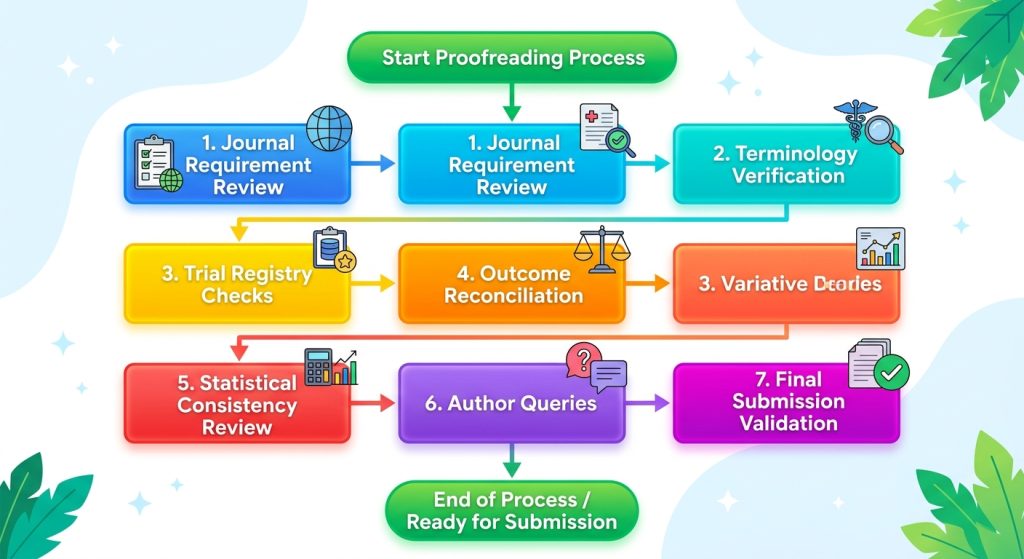
- Collect the source documents. Obtain the manuscript, target journal instructions, registry record, protocol, statistical analysis plan, reporting checklist, and relevant supplementary files.
- Complete the language and terminology review. Standardize spelling, abbreviations, drug names, clinical terms, and keyword usage.
- Verify trial registration. Check the registry name, identifier, registration chronology, and required disclosure locations.
- Reconcile outcomes and methods. Compare registered and reported endpoints, assessment times, analysis populations, and documented amendments.
- Audit numerical consistency. Compare abstract results, main-text findings, tables, figures, and supplementary data.
- Review disclosures and reporting requirements. Check ethics statements, funding, conflicts of interest, and relevant reporting checklists.
- Raise author queries. Document unresolved scientific, statistical, or ethical discrepancies without silently changing the underlying facts.
- Perform a final submission check. Verify the corrected manuscript against the journal’s latest instructions and confirm that all required files are ready.
Maintain an issue log with four fields: manuscript location, observed discrepancy, source used for verification, and required author action. This makes the review traceable and reduces the risk of overlooking unresolved issues.
Common pitfall: Treating the completion of a proofreading checklist as proof that the study is scientifically valid. A checklist establishes that specified checks were performed; it cannot replace peer review, statistical validation, ethics oversight, or regulatory assessment.
Medical Manuscript Proofreading: Key Standards at a Glance
The following table summarizes the principal resources and the role each plays in a medical manuscript compliance review.
| Standard or resource | Primary purpose | Proofreading priority |
| ICMJE recommendations | Editorial and clinical trial registration guidance | Registration timing and disclosure |
| MeSH | Biomedical indexing terminology | Keyword accuracy |
| CONSORT | Randomized trial reporting | Outcome and methods completeness |
| STROBE | Observational study reporting | Study design and results consistency |
| PRISMA | Systematic review reporting | Review methods and selection transparency |
| WHO ICTRP | Clinical trial registry platform | Registry discovery and transparency |
| Journal instructions | Publication-specific requirements | Formatting and submission compliance |
Pre-Submission Checklist for Medical Manuscripts
Before submitting a clinical research manuscript, confirm that you have completed the following checks.
- Verify medical terminology, drug names, abbreviations, and disease classifications.
- Check keywords against MeSH where appropriate.
- Confirm the clinical trial registry name and registration number.
- Compare the registration date with the date of first participant enrollment.
- Reconcile registered primary and secondary outcomes with the manuscript.
- Check outcome definitions, assessment time points, and documented amendments.
- Compare numerical results across the abstract, main text, tables, figures, and supplementary files.
- Verify statistical notation, units, confidence intervals, and p-values.
- Review ethics approval, informed consent, funding, conflicts of interest, and author contributions.
- Complete the reporting checklist appropriate to the study design.
- Apply the target journal’s reference style, formatting, and peer-review requirements.
- Resolve outstanding author queries before final submission.
Conclusion: Make Compliance Part of Medical Manuscript Proofreading
Medical manuscript proofreading is an essential quality-control stage in clinical research publishing. By verifying medical terminology, checking trial registry information, reconciling registered outcomes, and auditing numerical and editorial consistency, authors can identify preventable errors before submission.
The most effective approach combines language expertise with a documented compliance workflow. Proofreaders should correct errors within their remit, flag scientific discrepancies, and obtain author confirmation whenever a change could affect the interpretation of research findings.
Prepare your manuscript for a more confident submission. Explore ManuscriptLab’s professional editing and formatting services to improve clarity, consistency, and journal readiness.