Using generative AI to brainstorm, organize, edit, or even draft portions of a book or academic monograph is no longer unusual. The difficult question is what happens after the writing is complete: Can you claim copyright? Must you disclose the AI use? Will an academic press accept the manuscript? And who is legally and ethically responsible for the final text?
The answer is increasingly clear: AI assistance does not automatically prevent publication or copyright protection, but the extent of human authorship matters. In the United States, the U.S. Copyright Office has confirmed that copyright can protect human-authored contributions within a work containing AI-generated material. However, merely entering prompts into an AI system does not, by itself, establish sufficient human authorship in the resulting expression.
Academic and scholarly publishers impose an additional layer of responsibility. Oxford University Press (OUP), Cambridge University Press, and Elsevier all emphasize human accountability, transparency, and responsible use, although their specific requirements differ.
This guide explains how copyright, authorship, disclosure, intellectual property, and publishing ethics intersect when publishing an academic monograph with AI assistance in 2026.
💡 Need expert help with your paper?
Transform your manuscript with ManuscriptLab’s professional editing & formatting services!
1. Can You Copyright a Book Written With AI?
Yes but not necessarily every word in the book will receive the same copyright protection.
The critical distinction is between:
- material created by a human author;
- AI-generated material incorporated into a human-authored work; and
- material in which the expressive elements were determined substantially by the AI rather than by the human user.
The U.S. Copyright Office’s current position is based on a fundamental principle: copyright protects human creativity. Its 2025 report on generative AI concluded that existing copyright law is sufficiently flexible to evaluate AI-assisted works and that AI assistance does not automatically disqualify an otherwise copyrightable work.
For example, suppose you write a 90,000-word academic monograph and use an LLM to:
- brainstorm chapter structures;
- identify potential counterarguments;
- rewrite sentences for clarity;
- suggest transitions;
- summarize material that you subsequently verify;
- generate an initial paragraph that you substantially rewrite; and
- help reorganize your own analysis.
The resulting manuscript may contain extensive human-authored expression and editorial decisions. Your copyright claim can therefore cover the protectable human contribution.
The situation becomes more complicated if you instruct an AI system to generate entire chapters and publish the output substantially unchanged.
The key metric: human expressive contribution
There is no universally applicable percentage such as “80% human” or “20% AI.” Copyrightability is not determined by a simple word-count calculation.
Instead, evaluate who determined the expressive elements of the final work.
The Copyright Office has specifically stated that copyright can extend to human contributions such as creative selection, coordination, arrangement, and modification of AI-generated material. Merely supplying prompts is not necessarily enough.
That means an author’s intellectual contribution should remain visible in:
- the argument;
- organization;
- interpretation;
- original analysis;
- selection and arrangement;
- revisions;
- synthesis of sources;
- conclusions; and
- final expression.
Common pitfall
Do not assume that “I prompted the AI, therefore I wrote the passage.”
A detailed prompt can communicate your desired subject, tone, structure, or concepts, but the resulting prose may still have been generated by the system. The legal analysis focuses on the expressive contribution not simply the sophistication of the instruction.
Also read: 10 Key Reasons Manuscripts Get Rejected Before Peer Review
2. What Are the U.S. Copyright Office Requirements for Disclosing AI Assistance in Books?
This question requires an important distinction.
Publisher disclosure and copyright-registration disclosure are not necessarily the same thing.
The U.S. Copyright Office’s registration guidance requires applicants to identify AI-generated material when it is more than de minimis and to describe the human authorship being claimed. The Office’s guidance instructs applicants to use the Standard Application and identify the human-authored contribution. AI-generated material that is more than de minimis should generally be excluded from the copyright claim.
For example, an application could identify human authorship through language describing the author’s:
selection, coordination, and arrangement
of human-authored and AI-generated material.
The important practical lesson is this:
You do not normally list the AI system as a co-author.
The Copyright Office specifically states that applicants should not identify an AI technology or the company providing it as an author or co-author merely because it was used during creation.
What this means for a book
If your monograph contains AI-generated passages, preserve a record of:
- which sections involved AI;
- what the AI was asked to do;
- which output you retained;
- what you rewrote;
- what you independently researched and verified; and
- which portions represent your original intellectual contribution.
This documentation becomes especially useful if the copyright status of particular passages is later questioned.
Important limitation
U.S. copyright law is not universal copyright law.
If your book will be registered, licensed, or litigated in another jurisdiction, you need to examine that jurisdiction’s rules separately. Copyright protection, moral rights, authorship standards, and registration systems differ internationally.
For authoritative U.S. guidance, consult the U.S. Copyright Office’s Copyright and Artificial Intelligence resources.
3. How Do Academic Presses Regulate Generative AI?
Publisher policy can be more restrictive than copyright law.
This is one of the most important points for academic authors.
Copyright law asks whether particular expression qualifies for protection. A publisher asks a broader question:
Does this manuscript meet our standards for authorship, originality, scholarly integrity, confidentiality, and accountability?
The answer varies by press.
| Publisher/policy approach | AI-assisted preparation | AI-generated substantive text | Disclosure | AI authorship |
| U.S. Copyright Office | Permitted | May be incorporated, but protection depends on human authorship | Required in registration where applicable | AI cannot be author |
| Oxford University Press | Limited responsible use | Written permission may be required | Detailed disclosure | Not permitted |
| Elsevier Books | Permitted with oversight | Direct use of AI output as manuscript text is restricted | AI declaration required | Not permitted |
| Cambridge University Press | Certain uses permitted | Must comply with disclosure and originality requirements | Declaration/description expected | Not permitted |
Policies change, so treat this table as a 2026 snapshot rather than a permanent rulebook.
Oxford University Press
OUP’s current guidance emphasizes three principles:
authorship, accountability, and disclosure.
OUP does not regard generative AI as capable of performing primary authorial responsibilities such as generating scholarly arguments, scientific insights, analysis, or conclusions. It also requires authors to disclose AI use to their Acquisitions Editor and provide detailed information about the tool, version, use, location, justification, and validation process.
OUP also requires an AI Use Declaration Form as part of its book submission materials.
Elsevier
Elsevier’s July 2026 policy for books and commissioned content permits responsible use of AI tools but requires human oversight and accountability. Authors must verify AI output, check references, protect confidential material, and ensure the manuscript represents their authentic contribution. Elsevier requires an AI declaration statement upon submission.
Elsevier goes further by stating that authors should not use AI-agent or deep-research output directly as manuscript text.
Cambridge University Press
Cambridge likewise states that AI tools do not meet its requirements for authorship and emphasizes transparency, acknowledgment, citation, and compliance with plagiarism policies. Its guidance requires disclosure of AI-generated text and description of the process used.
The publishing implication is straightforward:
Never assume that because an AI-assisted book is legally copyrightable, every academic press will accept the way it was produced.
Also read: How to Get an AI Detection Report from Turnitin Before Submitting in 2026
4. What Counts as Ethical AI Assistance in Book Publishing?
A useful way to evaluate AI use is to classify it according to its impact on intellectual authorship.
Low-risk assistance
These uses are generally easier for publishers to accept, subject to individual policies:
- spelling and grammar correction;
- punctuation checks;
- readability improvements;
- identifying repetitive phrasing;
- brainstorming titles;
- generating an outline from your existing ideas;
- suggesting organizational alternatives;
- formatting assistance.
For example, Elsevier states that basic spelling, grammar, and punctuation tools do not require the same declaration as generative AI used to create substantive content.
Moderate-risk assistance
Exercise substantially more oversight when AI:
- summarizes research;
- proposes literature gaps;
- reorganizes arguments;
- generates explanatory passages;
- suggests interpretations;
- helps synthesize multiple sources;
- assists with reference organization.
Every factual assertion should be independently verified.
High-risk assistance
Use extreme caution when AI:
- writes complete chapters;
- generates original scholarly arguments;
- produces analysis or conclusions;
- creates literature reviews without source-by-source verification;
- generates quotations;
- generates citations without checking the underlying publications;
- produces research findings;
- creates figures from source material;
- transforms copyrighted third-party material.
OUP specifically prohibits AI from taking primary authorial responsibilities such as generating arguments and conclusions without appropriate authorization.
The ethical standard
Ask:
Could I defend every substantive claim in this book without saying, “The AI generated it”?
If the answer is no, the manuscript is not yet under sufficient authorial control.
5. Why AI Hallucinations Are a Copyright and Ethics Problem
One of the most serious risks in academic monograph publishing is the fabricated reference.
Generative AI can produce citations that look completely authentic:
- plausible author names;
- realistic journal titles;
- genuine publication years;
- incorrect DOIs;
- real articles attributed to the wrong authors;
- nonexistent books;
- quotations that were never published.
OUP specifically warns authors about hallucinated citations and requires authors to remain accountable for accuracy, originality, and integrity.
Do not treat an AI-generated bibliography as a scholarly bibliography.
Use a verification protocol
For every AI-suggested source:
- Search the original publisher, journal, library catalogue, or indexing database.
- Confirm the author list.
- Confirm the title.
- Confirm publication year and volume/issue information.
- Verify DOI or ISBN where applicable.
- Read the source yourself.
- Confirm that the source actually supports the claim.
- Replace or remove unsupported claims.
For medical or clinical monographs, also verify reporting and evidence standards against the relevant professional guidance rather than relying on an AI-generated summary.
Also read: How Much Percentage of AI Content Is Allowed in Research Papers?
6. Protect Your Intellectual Property Before Uploading a Manuscript
Copyright is not the only IP issue.
Confidentiality and contractual rights matter too.
Before uploading unpublished chapters, dissertation material, proprietary datasets, peer-review documents, commissioned chapters, or previously published material into an AI platform, inspect the tool’s terms of service.
Ask:
- Does the provider retain uploaded content?
- Can the provider use inputs for model training?
- Can you opt out?
- Does the provider claim rights over inputs or outputs?
- Does the service retain data for quality or abuse monitoring?
- Is the service suitable for confidential research material?
- Does your university, funder, employer, or publisher impose additional restrictions?
OUP specifically advises authors not to upload work intended for publication into GenAI tools that do not permit appropriate opt-outs from reuse or training.
Elsevier similarly requires authors to protect unpublished manuscripts, intellectual property, and personal information when using AI services.
A particularly important rule
Do not upload copyrighted material merely because you have access to it.
Access is not the same as permission.
A researcher may have institutional access to a journal article or a licensed database while lacking permission to upload the entire copyrighted work to an external AI system.
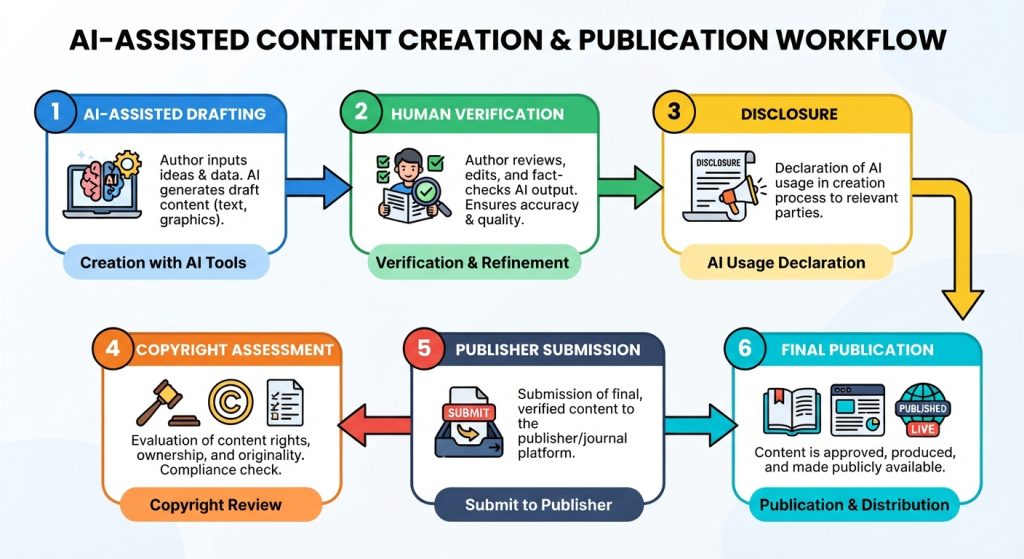
7. How Should You Disclose AI Usage to an Academic Book Publisher?
Do not hide AI use when the publisher requires disclosure.
A strong declaration should answer four questions:
What tool?
Identify the AI system and, where relevant, its version.
Why was it used?
For example, language editing, structural brainstorming, translation, reference organization, or drafting assistance.
Where was it used?
Identify the chapter, section, figure, appendix, or broader manuscript stage.
What did the author do afterward?
Explain how you verified, edited, validated, and assumed responsibility for the resulting content.
Elsevier provides a model declaration stating that the author identifies the tool and purpose, then confirms that the content was reviewed and edited and that the author takes responsibility for the publication.
OUP takes a more detailed approach, requiring information about the location, tool and version, manner and justification of use, and validation steps.
A practical disclosure template
Adapt the following only after checking your publisher’s exact requirements:
Generative AI disclosure: During preparation of this manuscript, the author used [AI TOOL] for [specific purpose]. AI-generated material was reviewed, fact-checked, substantially revised where applicable, and integrated under the author’s editorial and intellectual direction. The author assumes full responsibility for the accuracy, originality, interpretation, and final content of the work.
Do not copy this statement blindly into a submission. Publisher-specific language takes precedence.
8. Can an AI Tool Be Listed as a Co-Author?
Generally, no.
The reason is not simply that AI is “not a person.” Academic authorship carries substantive obligations.
An author must be able to:
- approve the final manuscript;
- accept responsibility for accuracy;
- respond to questions about the work;
- address allegations of misconduct;
- defend the originality of the research;
- disclose conflicts of interest;
- correct errors after publication.
An AI system cannot independently accept those responsibilities.
The U.S. Copyright Office likewise instructs applicants not to identify an AI technology as an author or co-author merely because it was used in producing the work.
Academic publishers reach the same conclusion. OUP, Cambridge, and Elsevier do not treat generative AI systems as authors.
9. What About AI-Generated Images, Figures, and Book Covers?
Text is not the only issue.
AI-generated visual material can raise separate questions involving copyright, permissions, likeness rights, scientific integrity, provenance, and publisher policy.
Do not assume that a publisher permitting AI-assisted text automatically permits AI-generated illustrations.
For example, Elsevier’s current books policy does not permit generative AI or AI-assisted tools to create or alter images in submitted book content, subject to an exception where AI use is part of the research methodology and is transparently documented.
Therefore, maintain an asset-level record for every AI-assisted figure:
- tool/model;
- version;
- prompt or workflow;
- source material;
- original image;
- modifications;
- human edits;
- permissions;
- final caption.
This is especially important for scholarly figures, clinical images, archival photographs, and maps.
10. A Safe AI-Assisted Workflow for Academic Monographs
The most defensible workflow is human-led, AI-assisted, and fully documented.
Step 1: Establish your intellectual architecture
Develop the research question, thesis, chapter logic, evidence base, and scholarly contribution yourself.
Step 2: Define acceptable AI uses
Decide in advance whether AI may be used for:
- brainstorming;
- language editing;
- structural suggestions;
- translation;
- reference organization;
- literature discovery;
- drafting.
Do not let the tool’s capabilities determine your ethical boundaries.
Step 3: Keep an AI-use log
Record:
| Field | Recommended record |
| Tool | Name and provider |
| Version | Model/version where available |
| Date | Date of use |
| Purpose | Editing, brainstorming, drafting, etc. |
| Location | Chapter/section |
| Output used? | Yes/No |
| Human revision | Brief description |
| Verification | Sources/checks performed |
| Disclosure | Publisher requirement satisfied? |
Step 4: Verify every substantive output
Treat AI-generated claims as unverified until independently confirmed.
Step 5: Rewrite for authentic authorship
Your final prose should reflect your scholarly voice, reasoning, evidence selection, interpretation, and conclusions.
Step 6: Audit third-party rights
Check quotations, tables, figures, images, archival materials, and reproduced passages independently.
Step 7: Check the publisher’s current AI policy
Do this before submitting the proposal, not after completing the book.
Step 8: Prepare the disclosure
Use the publisher’s required form or declaration and retain your underlying documentation.
Step 9: Assess copyright registration
If registering in the United States, accurately identify the human-authored contribution and exclude AI-generated material from the claim where required by the Copyright Office’s guidance.
Step 10: Preserve your evidence trail
Keep drafts, research notes, version histories, source records, and AI-use documentation. This is particularly valuable for a scholarly monograph whose provenance may be questioned years after publication.
Also read: Professional Manuscript Editing and Formatting Services
Pre-Submission AI & Copyright Checklist
Before submitting an AI-assisted book or monograph, confirm that you have:
- Developed the central thesis and scholarly contribution through your own intellectual work.
- Reviewed the target publisher’s current GenAI policy.
- Determined which AI uses require disclosure.
- Documented AI tools, versions, dates, and purposes.
- Independently verified every AI-generated citation.
- Fact-checked every substantive AI-assisted claim.
- Removed fabricated or unverifiable references.
- Reviewed the manuscript for plagiarism and unattributed third-party material.
- Confirmed that uploaded material did not violate confidentiality or licensing restrictions.
- Checked AI-tool terms regarding data retention, reuse, and training.
- Verified permissions for copyrighted images, tables, quotations, and archival materials.
- Confirmed whether AI-generated figures or artwork are permitted.
- Prepared the publisher’s AI declaration or disclosure form.
- Ensured that AI is not identified as an author or co-author.
- Identified the human-authored material appropriately if seeking U.S. copyright registration.
- Retained documentation demonstrating your human editorial and intellectual contribution.
Conclusion: AI Can Assist the Author But It Cannot Replace Authorial Responsibility
So, can you publish a book or monograph that AI helped you write?
In many circumstances, yes.
Can you copyright it? Human-authored portions can generally qualify for copyright protection, even when AI was involved in the creative process. The U.S. Copyright Office’s 2025 analysis makes clear that AI assistance does not automatically destroy copyrightability; what matters is the nature and extent of human creative contribution.
But publication is governed by more than copyright law. Academic presses increasingly require authors to demonstrate human authorship, scholarly accountability, transparency, source verification, and ethical control over AI-assisted material. OUP, Cambridge, and Elsevier all illustrate this trend, although their individual rules differ. The safest principle for 2026 is therefore simple:
Use AI as a controlled research and editorial instrument not as an invisible substitute for authorship.
Build the argument yourself. Verify the evidence yourself. Control the final language yourself. Document meaningful AI assistance. Disclose it when required. And check the publisher’s current policy before submission.
For authors preparing a dissertation-derived book, scholarly monograph, clinical text, or research-based publication, ManuscriptLab’s professional editing and formatting services can help ensure that the final manuscript is structurally coherent, professionally presented, and ready for publisher review.