Choosing the correct verb tense in a research paper can be surprisingly difficult. Researchers frequently switch between past, present, and present perfect tense without recognizing that these choices influence how readers interpret scientific claims. A Methods section written in the present tense may make completed procedures sound ongoing, while inconsistent tense usage in a Discussion section can blur the distinction between experimental findings and established scientific knowledge.
Verb tense in research papers refers to the grammatical choices researchers use to communicate when an action occurred, whether a finding remains relevant, and whether a statement represents an established fact or an interpretation. Each manuscript section has a different communicative purpose, so the appropriate tense depends on the information being presented.
Using the correct tense improves readability, strengthens scientific precision, and helps authors meet journal editorial expectations. Although APA, IEEE, and Vancouver publications share several conventions, their editorial requirements are not identical. Authors must distinguish general scientific writing principles from individual journal instructions.
This guide explains what tense to use in each research paper section, when to switch between tenses, how different referencing styles approach tense, and how to correct common grammatical problems before submission.
💡 Need expert help with your paper?
Transform your manuscript with ManuscriptLab’s professional editing & formatting services!
1. Understanding the Three Main Verb Tenses in Scientific Writing
Before deciding what tense to use in different manuscript sections, understand the three primary tense forms used in academic research.
Past tense: Reporting completed research activities
Use the past tense to describe actions, procedures, observations, and findings that occurred during a completed study.
Examples:
- The researchers collected blood samples from 120 participants.
- The intervention significantly reduced inflammatory markers.
- Previous studies reported similar outcomes.
The past tense establishes that an event occurred before the manuscript was written. It is particularly important when documenting experimental procedures and reporting study-specific findings.
Present tense: Communicating established facts and current interpretations
Use the present tense when describing established scientific knowledge, universally accepted principles, current interpretations, or information that remains valid at the time of publication.
Examples:
- Diabetes increases the risk of cardiovascular complications.
- Figure 2 illustrates the distribution of participants.
- These findings suggest a potential therapeutic application.
The present tense communicates that the statement has relevance beyond the original research event.
Present perfect tense: Connecting previous research with current knowledge
Use the present perfect tense to describe research that began in the past but remains relevant to current scientific understanding.
Examples:
- Previous studies have investigated the relationship between sleep quality and cognitive performance.
- Researchers have identified several biomarkers associated with disease progression.
- Several clinical trials have evaluated the effectiveness of this intervention.
This tense is particularly useful in literature reviews because it connects previous investigations with an ongoing research discussion.
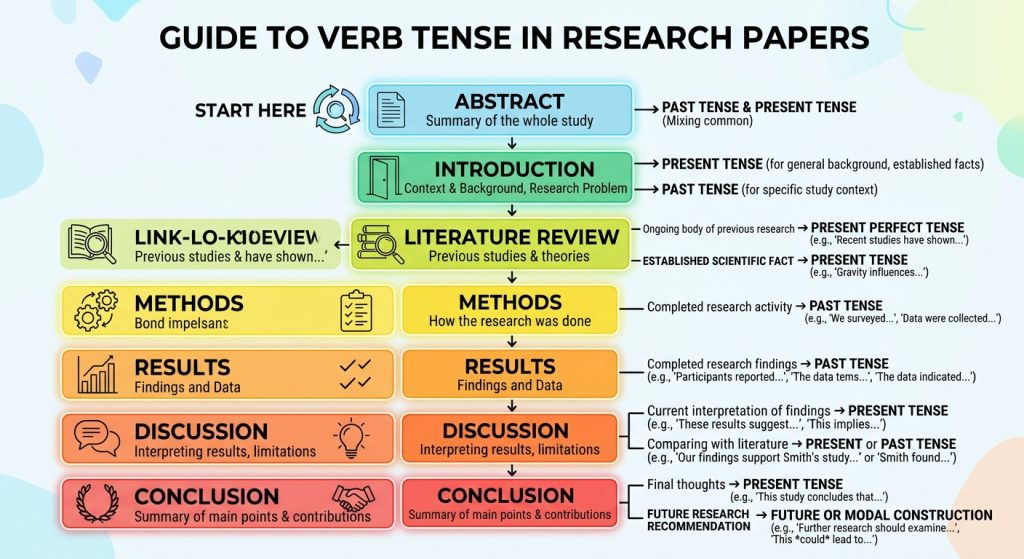
2. What Tense Should You Use in Each Research Paper Section?
The most reliable approach is to select tense according to the purpose of each section rather than applying one tense throughout the manuscript.
| Research paper section | Primary tense | Secondary tense | Main purpose |
| Title | Usually present or noun-based | Past, when appropriate | Identify the research topic |
| Abstract | Past and present | Present perfect | Summarize completed work and implications |
| Introduction | Present and past | Present perfect | Establish background and research gaps |
| Literature review | Past and present perfect | Present | Discuss previous research and current knowledge |
| Methods | Past | Present | Describe completed procedures and established protocols |
| Results | Past | Present | Report findings and refer to tables or figures |
| Discussion | Present and past | Present perfect, future | Interpret findings and explain implications |
| Conclusion | Present | Past and future | Summarize contributions and recommendations |
These are general conventions rather than universal journal requirements. Always consult the target journal’s instructions before finalizing your manuscript.
2.1 Abstract: Combine past and present tense strategically
The abstract summarizes the research objective, methodology, principal findings, and conclusions. Because these components perform different functions, using multiple tenses is appropriate.
Use past tense for:
- Research objectives that were investigated.
- Experimental procedures.
- Data collection and statistical analysis.
- Study-specific results.
Use present tense for:
- Established background information.
- The meaning of the findings.
- Conclusions that remain relevant.
Example:
“Background: Antibiotic resistance represents a growing global health challenge. Methods: We conducted a cross-sectional study involving 250 hospitalized patients. Results: The analysis identified a significant association between antibiotic exposure and resistant bacterial infections. Conclusion: These findings highlight the importance of antimicrobial stewardship programs.”
Notice how the background and conclusion use present tense, while the research procedures and findings use past tense.
Common pitfall: Writing the entire abstract in the past tense. This can make general scientific statements and continuing implications sound like historical events.
2.2 Introduction: Establish established knowledge and previous findings
The Introduction explains the research problem, summarizes existing knowledge, identifies limitations in previous investigations, and establishes the study objective.
Use present tense for established scientific facts:
“Chronic inflammation contributes to the development of several metabolic disorders.”
Use past tense when reporting a specific previous investigation:
“Smith et al. (2022) identified an association between inflammatory markers and disease progression.”
Use present perfect tense when describing a broader body of research:
“Several studies have investigated the relationship between chronic inflammation and metabolic dysfunction.”
Use present tense to introduce the research question or hypothesis:
“This study examines the association between inflammatory markers and disease severity.”
Common pitfall: Using present tense indiscriminately when discussing individual studies. A specific experiment occurred in the past, even when its findings remain scientifically relevant.
2.3 Literature Review: Use past and present perfect tense appropriately
The literature review requires careful tense selection because researchers discuss individual publications, accumulated evidence, and continuing research gaps.
Use the simple past when describing a specific study:
“Johnson et al. (2021) evaluated the effectiveness of cognitive behavioral therapy in patients with chronic insomnia.”
Use the present perfect when discussing multiple studies or an ongoing research trend:
“Several researchers have examined the effectiveness of cognitive behavioral therapy for sleep disorders.”
Use the present tense when describing established knowledge:
“Cognitive behavioral therapy is widely recognized as an evidence-based treatment for chronic insomnia.”
The distinction is important:
- Past: A particular research team completed an investigation.
- Present perfect: Multiple investigations have contributed to an ongoing body of evidence.
- Present: A finding or principle is currently accepted or remains applicable.
Common pitfall: Using present perfect for every citation. If you are reporting the specific actions or results of one completed investigation, simple past is often more precise.
2.4 Methods: Use past tense to describe completed procedures
The Methods section explains how the research was conducted. It must provide sufficient information for readers to evaluate and reproduce the investigation.
Use past tense when describing completed research activities:
- Participants were recruited from three hospitals.
- Blood samples were collected under sterile conditions.
- Data were analyzed using SPSS version 29.
- The researchers administered a standardized questionnaire.
The passive voice is common in this section because it can emphasize procedures, samples, and measurements rather than the researcher performing them.
Passive voice: “The samples were stored at −80°C.”
Active voice: “We stored the samples at −80°C.”
Both constructions are grammatically correct. Choose the voice that communicates the procedure most clearly and follows the journal’s editorial preferences.
Use present tense when explaining established methodological principles or referring to information in the manuscript:
“Table 1 presents the demographic characteristics of the participants.”
Why do journals require past tense in the Methods section?
Methods generally describe completed actions. Past tense establishes a clear chronological distinction between what researchers did and what they currently know. It also prevents readers from confusing a completed experiment with a proposed or ongoing procedure.
Common pitfalls:
- Switching between present and past without a change in meaning.
- Using passive constructions excessively.
- Describing completed procedures as though they are ongoing.
- Failing to distinguish established protocols from study-specific adaptations.
2.5 Results: Use past tense when reporting study findings
The Results section presents observations, statistical outcomes, and measurements obtained during the investigation.
Use past tense for completed findings:
- The intervention reduced blood glucose levels by 18%.
- A significant difference was observed between the experimental and control groups.
- Participants in the treatment group reported fewer adverse events.
When referring to tables and figures, use present tense because those elements exist in the manuscript:
“Table 2 shows the distribution of participants across treatment groups.”
“Figure 3 illustrates the relationship between treatment duration and clinical outcomes.”
This distinction separates the research event from the document’s presentation of that event.
Common pitfall: Using present tense for all results because the findings remain relevant. The experiment has already been conducted, so study-specific observations generally belong in the past tense.
2.6 Discussion: Combine past and present tense to distinguish findings from interpretation
The Discussion interprets results, compares them with previous research, explores possible explanations, acknowledges limitations, and considers implications.
Use past tense when referring to your specific findings:
“Our analysis revealed a significant association between treatment duration and patient outcomes.”
Use present tense when interpreting those findings:
“These findings suggest that longer treatment duration may improve clinical outcomes.”
Use past tense when describing a specific previous investigation:
“Brown et al. (2023) reported comparable improvements in treatment adherence.”
Use present perfect when connecting your findings with accumulated research:
“Previous studies have demonstrated similar associations between treatment adherence and clinical outcomes.”
Use future or modal constructions when identifying research directions:
“Future studies should investigate the long-term effects of this intervention.”
When should I use present tense instead of past tense in the Discussion section?
Use present tense when discussing what your findings mean now, interpreting their implications, or stating conclusions that remain relevant. Use past tense when describing what your study found or what another research team previously observed.
Common pitfall: Writing statements such as “The results indicated that the intervention improves patient outcomes” without considering whether the improvement is a finding from the completed experiment or a broader interpretation. Both tenses may be appropriate, but they communicate different levels of certainty and generality.
2.7 Conclusion: Emphasize current contributions and future directions
The Conclusion summarizes the research contribution and explains its significance.
Use present tense for the main conclusion:
“This study demonstrates the potential value of early screening in identifying high-risk patients.”
Use past tense when referring to completed research activities:
“The investigation evaluated three treatment protocols.”
Use future-oriented language when recommending additional research:
“Future investigations should examine the long-term effectiveness of these interventions.”
Avoid introducing unsupported claims or repeating the Results section in detail.
3. APA vs. IEEE vs. Vancouver: Are Verb Tense Rules Different?
One important distinction is that referencing systems and grammatical conventions serve different purposes.
APA, IEEE, and Vancouver primarily establish citation, reference, and publication-formatting conventions. They do not necessarily prescribe a completely different tense system for every manuscript section.
APA style
The American Psychological Association provides explicit recommendations for verb tense in its seventh edition Publication Manual.
Its general guidance includes:
- Past tense or present perfect for literature reviews.
- Past tense for methods and reporting results.
- Present tense for discussing implications and conclusions.
For example:
“Martin (2020) reported an improvement in patient outcomes.”
“Researchers have investigated similar treatment approaches.”
“The findings suggest important clinical implications.”
APA also emphasizes consistency and discourages unnecessary tense changes.
IEEE style
IEEE publications follow the IEEE Editorial Style Manual, which addresses technical writing, editorial conventions, abbreviations, mathematical expressions, and references.
IEEE does not establish a universal section-by-section tense table equivalent to APA’s recommendations. Authors should therefore apply established scientific writing principles while following the individual journal’s instructions.
For example:
“The proposed algorithm was evaluated using three benchmark datasets.”
“The results demonstrate improved computational efficiency.”
Vancouver style
Vancouver is primarily a numbered referencing system widely used in biomedical and clinical publications. It does not independently establish a universal verb-tense framework.
Authors publishing in Vancouver-style journals should follow the target journal’s language and editorial instructions, alongside established biomedical writing conventions.
For example:
“Previous investigations reported comparable clinical outcomes (1,2).”
“These findings support further evaluation of the treatment.”
| Criterion | APA | IEEE | Vancouver |
| Primary application | Social and behavioral sciences | Engineering and technology | Biomedical and medical research |
| Reference system | Author–date | Numbered | Numbered |
| Explicit tense recommendations | Yes | No universal section-based tense table | No universal section-based tense table |
| Methods convention | Primarily past | Primarily past | Primarily past |
| Results convention | Primarily past | Primarily past | Primarily past |
| Discussion convention | Present and past | Present and past | Present and past |
Editorial recommendation: Never assume that selecting Vancouver or IEEE referencing automatically determines your manuscript’s verb tense. Check the target journal’s author guidelines and published article examples.
Also read: How to Identify and Write a Research Gap Statement in 2026
4. Common Verb Tense Mistakes in Research Papers
Even experienced researchers make tense-related errors. These mistakes can reduce clarity and weaken the professional presentation of an otherwise strong manuscript.
Mistake 1: Using present tense for completed procedures
Incorrect: “The researchers collect samples from 100 participants.”
Correct: “The researchers collected samples from 100 participants.”
The corrected sentence accurately describes a completed research activity.
Mistake 2: Using past tense for established scientific facts
Incorrect: “DNA was composed of nucleotide sequences.”
Correct: “DNA is composed of nucleotide sequences.”
The present tense communicates an established biological principle.
Mistake 3: Overusing present perfect in literature reviews
Incorrect: “Smith et al. (2022) have investigated the relationship between diet and inflammation.”
Better: “Smith et al. (2022) investigated the relationship between diet and inflammation.”
The simple past is more appropriate when reporting a specific completed study.
Mistake 4: Shifting tense without a logical reason
Incorrect: “The participants completed the questionnaire, and the researchers analyze the responses.”
Correct: “The participants completed the questionnaire, and the researchers analyzed the responses.”
Both actions occurred during the completed investigation.
Mistake 5: Confusing findings with interpretations
Incorrect: “The intervention reduced inflammation, and these results indicated a potential clinical benefit.”
Improved: “The intervention reduced inflammation, and these results indicate a potential clinical benefit.”
The first clause reports an observed result; the second interprets its current significance.
Also read: Pre-Submission Peer Review: 7 Ways to Assess Novelty and Rigor for High-Impact Journals in 2026
5. Is It Acceptable to Shift Verb Tenses Within the Same Paragraph?
Yes. Changing verb tense within a paragraph is acceptable when the time relationship or purpose of the statement changes.
Consider the following example:
“Previous studies have investigated the relationship between physical activity and cardiovascular health. In 2023, researchers conducted a randomized controlled trial involving 300 participants. The trial demonstrated a significant improvement in cardiovascular fitness. These findings suggest that structured exercise programs can improve long-term health outcomes.”
The paragraph contains:
- Present perfect: accumulated previous research.
- Past: a completed clinical trial.
- Past: the trial’s specific findings.
- Present: the current interpretation and broader implication.
Each tense serves a distinct purpose.
However, avoid changing tense simply to create stylistic variation. A grammatical tense shift must communicate a meaningful change in time, evidence, or interpretation.
6. Practical Strategies for Maintaining Verb Tense Consistency
Apply these editorial practices before submitting your manuscript.
6.1 Identify the purpose of every sentence
Ask whether the sentence describes a completed action, a current fact, a previous publication, or an interpretation. Select the tense accordingly.
6.2 Audit each manuscript section separately
Review the Introduction, Methods, Results, and Discussion independently. Check whether the predominant tense matches the section’s purpose.
6.3 Use a grammar checker carefully
Tools such as Microsoft Word Editor and other academic proofreading applications can identify potential grammatical inconsistencies. However, automated systems may not understand the scientific meaning behind a tense change.
Treat automated suggestions as editorial prompts, not unquestionable corrections.
6.4 Compare your manuscript with published journal articles
Examine recently published papers in your target journal. Pay attention to how authors describe procedures, report findings, cite previous studies, and interpret results.
6.5 Complete a professional language review
A professional academic editor can identify tense inconsistencies, awkward passive constructions, unclear claims, and sentence-level grammatical problems.
Explore ManuscriptLab’s professional editing services to improve the clarity and consistency of your research manuscript.
7. Research Paper Verb Tense: Quick Reference Examples
Use this table as a practical reference while drafting or editing your manuscript.
| Writing purpose | Recommended tense | Example |
| Established scientific fact | Present | Protein synthesis occurs in ribosomes. |
| Completed experiment | Past | We measured protein expression. |
| Specific previous study | Past | Lee et al. reported significant improvements. |
| Ongoing research trend | Present perfect | Researchers have investigated this pathway. |
| Study methodology | Past | Participants completed the survey. |
| Study findings | Past | The treatment reduced inflammation. |
| Table or figure reference | Present | Figure 2 illustrates the results. |
| Interpretation | Present | These findings suggest a potential mechanism. |
| Study limitation | Present | This study has several limitations. |
| Future research | Future/modal | Further studies should examine long-term outcomes. |
Visual diagram placeholder:
Also read: 10 Key Reasons Manuscripts Get Rejected Before Peer Review
8. Frequently Asked Questions About Verb Tense in Research Papers
1. Why do journals require past tense in the Methods section?
The Methods section documents research procedures that have already been completed. Past tense establishes that these activities occurred before publication and helps readers distinguish completed experiments from proposed procedures. However, some methodological descriptions, established protocols, and references to figures may appropriately use other tenses.
2. When should I use present tense instead of past tense in the Discussion section?
Use present tense to explain the current significance of findings, interpret results, describe established scientific principles, and communicate conclusions. Use past tense when reporting specific observations from your completed study or describing the results of a particular previous investigation.
3. Is it acceptable to shift verb tenses within the same paragraph of a research paper?
Yes. Tense changes are acceptable when they reflect different time relationships or communicative purposes. For example, a paragraph can describe previous studies using past tense, discuss accumulated evidence using present perfect, and explain current implications using present tense. Avoid unnecessary or unexplained shifts.
4. How does APA style differ from IEEE or Vancouver regarding verb tense in literature reviews?
APA 7 provides explicit recommendations, generally favoring past or present perfect tense when discussing previous research. IEEE and Vancouver primarily govern editorial formatting and referencing conventions rather than prescribing a universal literature-review tense framework. Authors should apply scientific writing principles and follow individual journal instructions.
5. Should the entire research paper be written in past tense?
No. Different sections have different purposes. Methods and Results generally use past tense, while established facts and interpretations often require present tense. Literature reviews commonly combine past and present perfect tense. Appropriate tense variation improves scientific accuracy.
6. Should I use passive voice in the Methods section?
Passive voice is acceptable when the procedure or material is more important than the person performing the action. However, active voice can improve clarity and reduce unnecessarily complicated sentences. Follow the target journal’s editorial preferences.
9. Pre-Submission Verb Tense Checklist
Before submitting your research paper, complete the following editorial checks:
- The abstract uses past tense for completed procedures and results.
- The introduction uses present tense for established facts.
- Specific previous studies are generally described in past tense.
- Present perfect tense is used appropriately for accumulated research.
- The Methods section describes completed procedures in past tense.
- The Results section reports study-specific findings in past tense.
- Tables and figures are referenced in present tense.
- The Discussion distinguishes observed findings from current interpretations.
- The Conclusion communicates the research contribution clearly.
- Future research recommendations use appropriate future or modal constructions.
- Unnecessary tense shifts have been corrected.
- The manuscript follows the target journal’s author guidelines.
Conclusion
Correct verb tense is essential for clear, accurate, and professional scientific communication. The central principle is straightforward: use past tense to describe completed research activities and observations, present tense to communicate established knowledge and current interpretations, and present perfect tense to connect previous research with ongoing scientific understanding.
However, effective academic writing requires more than memorizing grammatical rules. Researchers must understand the purpose of each manuscript section, distinguish evidence from interpretation, and maintain logical tense consistency throughout the paper.
Before submission, review your manuscript against the target journal’s editorial requirements and correct any unnecessary tense shifts. If your paper requires a more comprehensive language assessment, ManuscriptLab’s academic editing and manuscript formatting services can help strengthen its clarity, consistency, and publication readiness.